
My research focuses on the fundamental and applied aspects of fluid mechanics, fluid–structure interactions (FSI), and renewable energy systems. The central theme of my work is understanding the complex interactions between fluid flow and deformable, vibrating, or moving structures, and translating this knowledge into practical engineering solutions. My research interests include:
Flow-induced vibrations (vortex-induced vibration, galloping, flutter, wake-induced vibration, and related instability phenomena)
Fluid–structure interactions involving rigid and flexible bodies
Bluff-body aerodynamics and hydrodynamics (wake, vortex shedding, and forces)
Wind and ocean current energy harvesting using oscillating structures
Bio-inspired fluid dynamics, fish swimming, and aquatic locomotion
Hydrodynamics and propulsion of underwater vehicles and robotic swimmers
Aerodynamics of airfoils, flexible wings, and morphing structures
Flow control, drag reduction techniques, and flow-induced noise
Wind engineering and wind loads on civil structures
Heat transfer and thermo-fluid systems
Experimental, numerical, and theoretical fluid mechanics
Renewable energy harvesting
My research combines experimental measurements, computational fluid dynamics (CFD), fluid–structure interaction simulations, reduced-order modeling, and theoretical analyses to investigate flow physics across a wide range of Reynolds numbers and bluff-body shapes. Particular emphasis is placed on understanding wake behavior, vibration mechanisms, energy transfer processes, and biologically inspired propulsion systems. The outcomes of this work contribute to the development of efficient energy-harvesting devices, safer engineering structures, advanced transportation systems, and next-generation bio-inspired robotic technologies.
(i) Durability of Building Materials, Plain and Reinforce Concrete in Aggressive Environment (Marine Environment, Arid, Hot & Humid Climates, Tropical / Arctic / Polar Climates, Concrete Subjected to Alternate wetting / drying and large hydrostatic pressures etc.).
(ii) Suitability and Effectiveness of Supplementary Cementitious materials (SCM) as Page 5 of 15. partial replacement of Cement, admixture / paint / coatings for concrete / embedded rebars exposed to adverse environment.
(iii) Assessment of damage caused due to corrosion of embedded reinforcement in concrete structures and rehabilitation of the damaged structures.
(iv) Non destructive test (NDT) techniques for predicting service life of existing structures.
(v) Ultimate and Limit state behavior of R. C. and P. C. Structure.
- Area of Specialization
- Aerodynamics of Long-span Bridges
- Aeroelastic Analysis of Flexible Structures
- Aerodynamic Countermeasures of Flexible Structures and Bluff Bodies
- Computational Fluid Dynamics (CFD)
- Seismic Response of Structures
Research Project
Research Project Title: “Far Surface Mounted Reinforcement for Flexural Strengthening of Reinforced Concrete Beam “
Period: 01/07/2019 to 30/06/2021
Funded By: BANBEIS under the Ministry of Education
Position: Co-PI
Reviewer
Engineering Structures
International Journal of Structural Stability and Dynamics
Engineering Application of Computational Fluid Mechanics
Earthquake Engineering and Engineering Vibration
Wind and Structures. An International Journal
Structures
Scientific Reports
Asian Journal of Civil Engineering
Research on Engineering Structures and Materials
Physics of Fluids
Structural Engineering and Mechanics
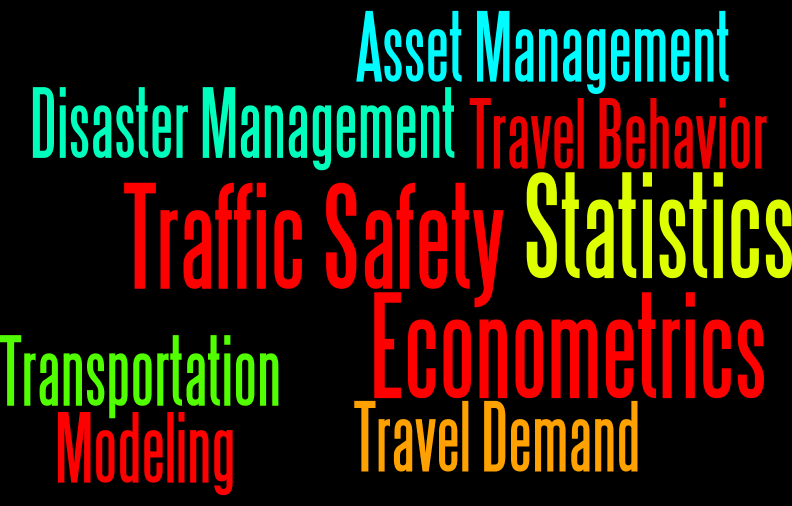
- Transportation,
- Traffic safety,
- Econometric statistical analysis,
- Naturalistic driving study,
- Infrastructure and disaster management,
- Public transportation.
Investigation of the mechanical properties of conventional and innovative construction materials.
Integration of sustainability principles in infrastructure development and assessment.
Application of machine learning algorithms for predicting structural performance and material behaviour.
Practical implementation of advanced structural analysis techniques in real-world civil engineering projects.
Development and validation of numerical models to simulate complex structural behaviours.
- Structural Dynamics
- Soil Dynamics
- Probabilistic Methods in Geotechnical & Structural Engineering
- Finite Element Methods in Civil Engineering.
Dr. Billah's research interests span several interdisciplinary domains, emphasizing the application of advanced techniques to address critical engineering challenges. Primary focus areas include transportation safety, investigating strategies to reduce accidents and enhance the safety of vulnerable road users through data-driven approaches. Research efforts also involve water resources modeling, exploring sustainable and efficient methods for managing water systems. Additionally, machine learning techniques are applied to enhance predictive modeling in both transportation safety and resource management. Another key area of interest is the use of solid wastes in construction materials, aiming to promote sustainable building practices by incorporating waste materials into construction processes. Dr. Billah also conducts research on assessing the water quality of water bodies, investigating methods to monitor and improve the quality of freshwater and coastal systems. The overarching goal of his research is to integrate innovation and technology to tackle pressing challenges in urban infrastructure, environmental systems, and sustainability.
Research Grants:
- University Grants Commission (UGC)- Higher Education Acceleration and Transformation (HEAT) project: Development of Carbon-Based Porous Materials from Waste Resources for Sustainable Energy, Environmental, and Desalination Applications (3.7 crore BDT ~ 301,715 USD) Duty: Project Member [May 2025- May 2028].
- East West University-Center for Research and Training (EWUCRT) Project: Assessing the Reuse Potential of Water Collected from the Air Conditioning Units of East West University: A Pilot Study on Air Condensate Harvesting (25.15 lac BDT ~ 20600 USD) Duty: Principal Investigator [November 2025- April 2027]
Research Interests:
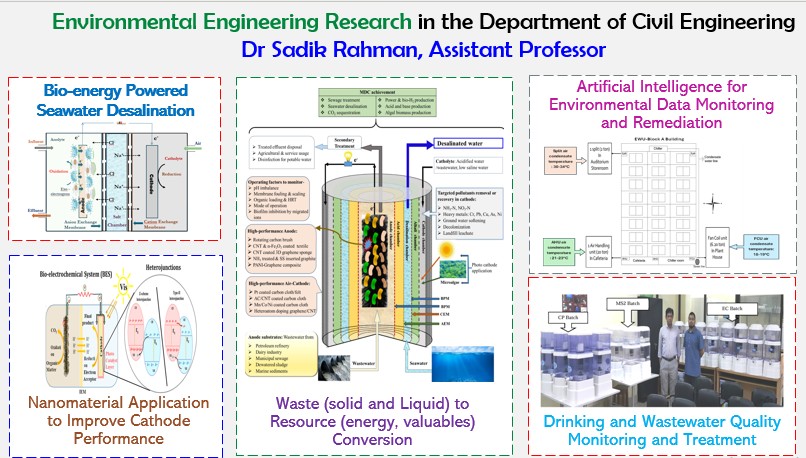
- Bioelectrochemical wastewater treatment and desalination
- Anaerobic digestion
- Waste to resource (energy, valuables) nexus
- Drinking water quality monitoring and treatment
- AI application on environmental remediation
- Life Cycle Analysis (LCA)
- Emerging transport
- Sustainable mobility
- Travel behaviour
- Transport planning and policy
- Transport and land use
- Urban mobility
- Transportation Planning
- Urban Planning
- Travel Behavior Analysis
- Road Safety and Accident Analysis
- Land Use
- Sustainable Transportation System
- Structural Health Monitoring
- Structural Dynamics
- Numerical Analysis
- Concrete Materials
- Seismic Engineering
- Steel Structure
- Wastewater Treatment and Reuse
- Life Cycle Assessment
- Risk Assessment
- Clean Energy
- Zero Emission Structure
- Rural Water Supply and Sanitation Project
- Arsenic Mitigation Water Supply Project
Geotechnical related issued (Sand Drain, Jet Grouting, Shake Table Test, Earthquake, Modeling by PLAXIS 3D software)
Research Gate Score: 9.68 (https://www.researchgate.net/profile/Ripon-Hore/research)
Geopolymer concrete (Concrete without cement), Strengthening of reinforced concrete structures
using polymers, Effect of strengthened structure under static and cyclic loadings, Non-linear finite
element analysis of strengthened structures.